
This article highlights a few effective breathing techniques that promote relaxation/stress reduction aincrease respiratory efficiency. You do not need formal yoga practice experience or any extensive training to learn these simple and effective techniques. Simply read through each section, and experiment with your own body and breath.
The basics of breathing
Just breathe! is a common phrase used in the media and by many health providers. However, it’s not enough to simply “breathe,” it must be done effectively. If you’re holding your breath or hyperventilating, you are technically breathing, but just not as effectively as possible. In fact, it has been shown that this type of shallow rapid breathing can actually make you feel more stress during trying times.
We know through research that psychological stress plays a role with asthma. It can make asthma more difficult to control and increase the likelihood of asthma flares. And it can also increase the duration and severity of symptoms. Breath control and meditation practices have been shown to play an important role in stress reduction and asthma control.
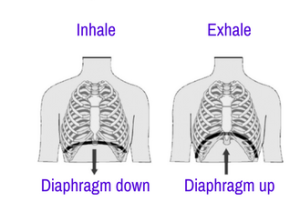
In order to practice effective breathing, it’s important to understand the role of the diaphragm in optimal respiration. Our diaphragm is a major muscle of the respiratory system involved in the expansion of the rib cage and rising of the chest under voluntary control. When we inhale, the diaphragm contracts and moves down; when we exhale the diaphragm relaxes and it moves up. The greater the degree of movement of the diaphragm between inspiration and respiration, the greater the tidal volume – amount of air that moves in or out of the lungs with each respiratory cycle. Controlled diaphragmatic breathing (taking in slow, deep breaths) increases tidal volume and has been shown to improve ventilation efficiency of the lungs, pulmonary gas exchange and arterial oxygenation. Furthermore, the lung base has the greatest blood flow/perfusion and is often not utilized in thoracic (shallow/rapid) breathing; diaphragmatic breathing allows one to activate the bases of the lungs.
Breathing and the autonomic nervous system
The autonomic nervous system has two arms that exert opposing control over the heart – sympathetic (fight-or-flight/cardiac acceleration) and parasympathetic (relaxation/cardiac slowing). Parasympathetic activity is the dominant arm of the autonomic nervous system, providing a homeostatic level of control over the heart rate under resting conditions. Prolonged periods of stress can set an imbalance to the autonomic system with a shift toward more sympathetic activity.
Heart Rate Variability (HRV) is an interesting and noninvasive way to identify imbalances in the autonomic system. It is measured as specific changes in time (or variability) between successive heart beats. When one is more frequently activating the parasympathetic nervous system such as when under stress, the variation between subsequent heartbeats is low. If one is in a more relaxed state, the variation between beats is high. In other words, the healthier one is, the faster you are able to switch gears, showing more resilience and flexibility. Over the past few decades, research has shown a relationship between low HRV and worsening depression or anxiety.
Breathing techniques like 4-7-8 (5) breathing and box breathing can help you tap into your inner calm, benefiting everything from your stressed-out nervous system to how well you sleep at night.
4-7-8 (5) Breathing?
The 4-7-8 breathing technique is a style of intentional breath work that can calm your mind and body. Though popularized in 2015 by integrative medicine specialist Andrew Weil, MD, it has ancient roots in the yogic practice of pranayama, or focusing on the breath. One of the best breathing methods to increase the pH of your blood (remember low pH =acidic and high pH = alkaline) is when we exhale for significantly longer than we inhale.
Here’s how to do it:
Inhale through your nose for four counts.
Hold your breath for seven counts.
Exhale through your mouth for eight counts.
Breath normal for 5 second, I added this count as you can get light headed when you start doing this exercise.
Relax your face, neck and shoulders while you are doing this exercise.
The benefits of 4-7-8 breathing
Calm your mind
The repetitive nature of 4-7-8 breathing provides a calming distraction to your racing mind. The counting sequence is a way to focus your mind on something other than your worries.
Reduce stress and anxiety
Your sympathetic nervous system is responsible for your body’s “fight-or-flight” response. When you’re stressed, this system goes into overdrive, which makes you feel amped-up — like a fast-beating heart, shallow breathing and other telltale signs of stress, like sweaty hands and an upset stomach.
Your parasympathetic nervous system is responsible for relaxing your sympathetic nervous system and helping you calm down. Breathing techniques like 4-7-8 breathing can play a huge role in activating your parasympathetic nervous system and helping you to shift back toward tranquility.
Help you sleep
By counting your breath you are calming your mind and reducing your anxiety and that can go a long way towards a good night’s sleep. It’s also been shown to decrease heart rate and blood pressure, which put your body in the right state for sleep.
Train your body to better respond to stress
With practice and repetition, you can teach your nervous system to do some pretty cool things. It takes some time for the nervous system to respond to this type of breath work, but the more we do it, the more we allow our bodies to go into that parasympathetic mode.
Changing PH in Body
Our blood is supposed to remain in a very limited range of a pH of 7.3-7.4 for us to have proper amounts of energy production and life-giving nutrient delivery to all our body’s tissues. The pH balance in our blood affects almost every bodily function. When we practice breath work, we take up more oxygen than we should do with regular shallow breathing. This increase of O2 helps to expel more CO2 from the body. Lower Hydrogen ion concentrations means less acidity and shifts the blood PH to a more alkaline state. By controlling our breath, we can very positively influence the pH of our blood.
You may feel slightly light headed when you are initially doing this exercise.
Bicarbonate production
Bicarbonate acts as a buffer to neutralize acidity in the blood. This is a normal function in the body. With Breath work the bicarbonate production increases and promotes a more alkaline environment. This buffer aids in keeping the pH levels in balance.
